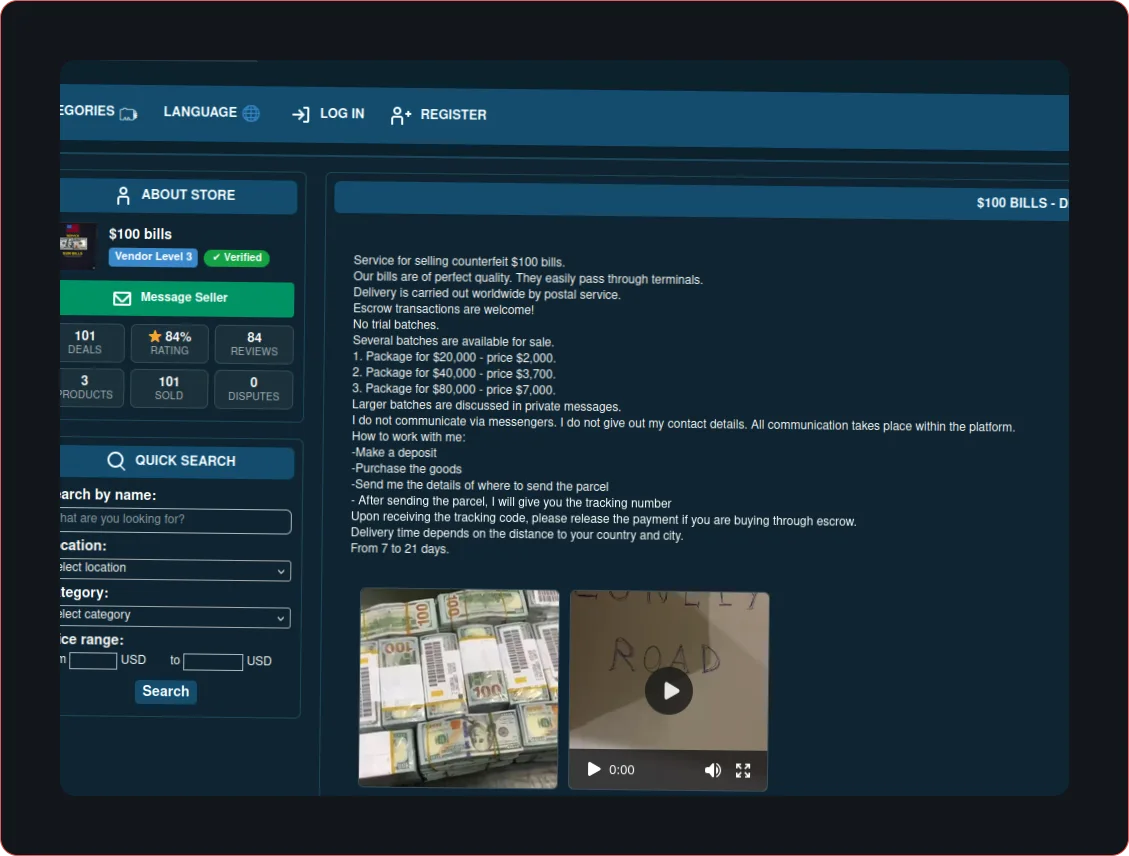
In 2025, a 29-year-old named Derek H. from Denver, Colorado, initiated a scheme he thought would be foolproof. In January 2025, $1,200 in cryptocurrency was used by Derek to obtain 40 counterfeit $100 bills from the 2009 series via a darknet marketplace. Claiming that they possessed realistic features to pass basic inspections, the seller promoted these bills as having "superdollar quality," which included functional UV protection, magnetic strips, and watermarks. Planning to deposit counterfeit currency into cash-accepting ATMs, Derek intended to wait for the machines to credit his account and then withdraw or transfer the funds as legitimate digital currency before any alerts could be triggered.
Initially, it seemed that Derek's endeavor was successful. The first two ATMs processed $800 in counterfeit money without any issues. When he tried to use a third ATM, complications emerged as one of the bills was rejected and an error message was displayed. Undeterred, Derek moved to a fourth ATM that accepted the bill but flagged the transaction for further scrutiny. By the next morning, his bank had completely frozen his account due to these activities. An arrest warrant was presented at his home by agents from the U.S. Secret Service just three weeks after the incident. This situation prompts a critical inquiry: how did Derek's seemingly sound plan collapse so quickly, and what mistakes led him to mistakenly believe that ATMs were vulnerable points in the banking security framework?
Key takeaways
ATMs provisionally credit deposits before completing forensic bill analysis, creating a false impression of successful fraud.
Banks cross-reference serial numbers and magnetic signatures against Secret Service databases of known counterfeit series.
Depositing cash in unusual patterns triggers behavioral alerts separate from currency authenticity checks.
Cryptocurrency purchases on darknet markets leave blockchain trails investigators can trace through exchange records.
Federal counterfeit currency charges carry up to 20 years per count regardless of the amount involved.
Why did the first ATMs accept the fake bills without immediate rejection?
Modern cash-accepting ATMs rely on a tiered verification process that doesn't always reject suspicious currency on the spot, especially when you're dealing with high-quality counterfeit $20 dollar bills or larger denominations. When Derek fed his 100 dollar fake money into the first two machines, the initial scanners checked for basic magnetic ink patterns, paper thickness, and UV fluorescence—all features the darknet seller had replicated convincingly enough to pass this front-line screening. The ATMs provisionally credited his account because their programming prioritizes customer convenience, accepting borderline bills and flagging them for backend review rather than causing immediate disputes at the machine. You should understand that the $800 credited to Derek's balance was never truly "cleared" in the bank's ledger; it existed in a provisional state while automated systems queued the scanned bill images for secondary analysis. Financial institutions use this delay to avoid frustrating customers whose legitimate worn currency might trigger false positives, but it also creates a window where fake dollar price arbitrage seems possible to fraudsters. The third ATM's outright rejection likely occurred because its sensors detected a specific flaw—perhaps inconsistent serial number fonts or a watermark misalignment—that crossed a higher confidence threshold for fraud, while the fourth machine's "pending review" status meant the bill fell into a gray zone requiring human or advanced AI examination.
How did the bank identify the counterfeit notes after initial acceptance?
When counterfeit notes are submitted to an ATM, the process of review is far more intricate than one might assume. Behind the scenes, banks initiate extensive verification procedures that surpass what any counterfeiter could anticipate. Centralized fraud detection systems are employed to compile data from all ATM transactions, meticulously analyzing high-resolution images of each deposit for subtle discrepancies in engraving depth, color fidelity of the Treasury seal, and alignment of security threads that can be seen under specific lighting conditions. A notable weakness in Derek's 100 dollar notes was that they bore identical serial numbers, a frequent error made by counterfeiters working with limited runs. This pattern raised red flags as the bank's software cross-checked his deposits against a national database of known counterfeit series, which is maintained by the Secret Service.
In genuine currency, a magnetic strip contains encoded data that corresponds to the bill's printed face value. Although the vendor on the darknet claimed that they had functional strips, forensic examinations showed that the magnetic signature differed slightly from standard Federal Reserve patterns. It is essential for you to understand that even the most advanced fake money producers face challenges in replicating the intricate microprinting found on Benjamin Franklin's collar. This detail requires magnification to discern and varies subtly between different print runs; Derek's notes did not pass this inspection when analyzed under the bank's digital microscopes. Subsequently, human examiners conducted comparisons of the flagged notes with reference samples from the Treasury Department, ultimately confirming that the watermarks lacked the three-dimensional quality characteristic of authentic currency and that the color-shifting ink in the "100" denomination did not shift accurately from copper to green at the required viewing angles.
What mistakes made Derek's scheme detectable beyond the counterfeit quality?
Even if you somehow obtained perfect counterfeit money, Derek's behavioral patterns and transaction choices created red flags that algorithmic monitoring systems are designed to catch. Depositing $4,000 in cash through ATMs over a short span—especially in $100 increments—deviates sharply from typical consumer banking behavior, triggering velocity alerts that flag accounts for sudden unusual activity regardless of whether the currency is genuine. Banks track your historical deposit patterns, and Derek's account showed no prior cash-heavy transactions, making the January 2025 spike statistically anomalous and worthy of immediate investigator attention. The decision to buy fake dollars through a darknet marketplace also left a cryptocurrency trail; while Derek believed his Bitcoin purchase was anonymous, blockchain forensics allowed investigators to trace wallet addresses back through exchange KYC records once they obtained subpoenas after his arrest. You should note that attempting multiple ATMs in quick succession—especially after one rejection—signals awareness of potential fraud, as legitimate customers would typically contact their bank after a single machine error rather than shopping for more permissive hardware. Derek's geographic movement between four ATMs within hours created a location pattern that matched known fraud typologies, where criminals test counterfeit batches across multiple machines to maximize acceptance before detection systems synchronize data. The final error was assuming ATM acceptance equaled successful fraud completion; modern banking separates provisional credit from final settlement, meaning Derek never actually "owned" the digital dollars until the bank's 72-hour review period cleared, which it never did once forensic teams began their examination.
Why surface-level technology exploits collapse under institutional scrutiny
Derek H.'s case illustrates why shortcuts that seem to exploit technological gaps—like feeding buy counterfeit 20 dollar bills into automated deposit machines—ultimately fail against layered institutional defenses you can't observe from outside. The combination of advanced bill-scanning hardware, centralized fraud analytics comparing every transaction against national databases, and behavioral monitoring that flags statistical anomalies creates a detection net far tighter than any prop money for sale nearby vendor can prepare you to defeat. Federal prosecutors charged Derek with possession and uttering counterfeit obligations, crimes carrying up to 20 years per count, and the Secret Service traced his cryptocurrency payments back to the fake money darknet marketplace where the transaction originated.
Investigators used blockchain analysis to identify the darknet marketplace where Derek purchased the counterfeit bills, leading to additional charges related to the cryptocurrency transaction.
FAQ
Can high-quality counterfeit bills pass ATM deposit verification?
Initial ATM sensors may provisionally accept sophisticated counterfeits, but backend forensic systems examine high-resolution scans for microscopic flaws in microprinting, watermark depth, and magnetic strip encoding that no counterfeit replicates perfectly. Banks delay final credit until this secondary review completes, typically within 72 hours.
How do banks detect counterfeit money after ATMs accept deposits?
Financial institutions use centralized fraud systems that compare scanned bill images against Treasury reference samples, checking for serial number duplications, incorrect magnetic signatures, and deviations in security thread placement or color-shifting ink behavior. Human examiners verify flagged bills under magnification and specialized lighting.
What behavioral patterns alert banks to potential counterfeit deposit schemes?
Sudden increases in cash deposits that deviate from your historical account activity, multiple ATM transactions in short timeframes especially after machine rejections, and geographic patterns matching known fraud typologies all trigger algorithmic alerts separate from currency authenticity checks. Banks monitor transaction velocity and location data continuously.
Why did Derek's cryptocurrency payment lead to additional charges?
Blockchain analysis allowed investigators to trace Derek's Bitcoin wallet through exchange Know Your Customer records once subpoenas were issued, connecting him directly to the darknet vendor and adding charges related to the purchase transaction itself beyond the counterfeit possession counts.