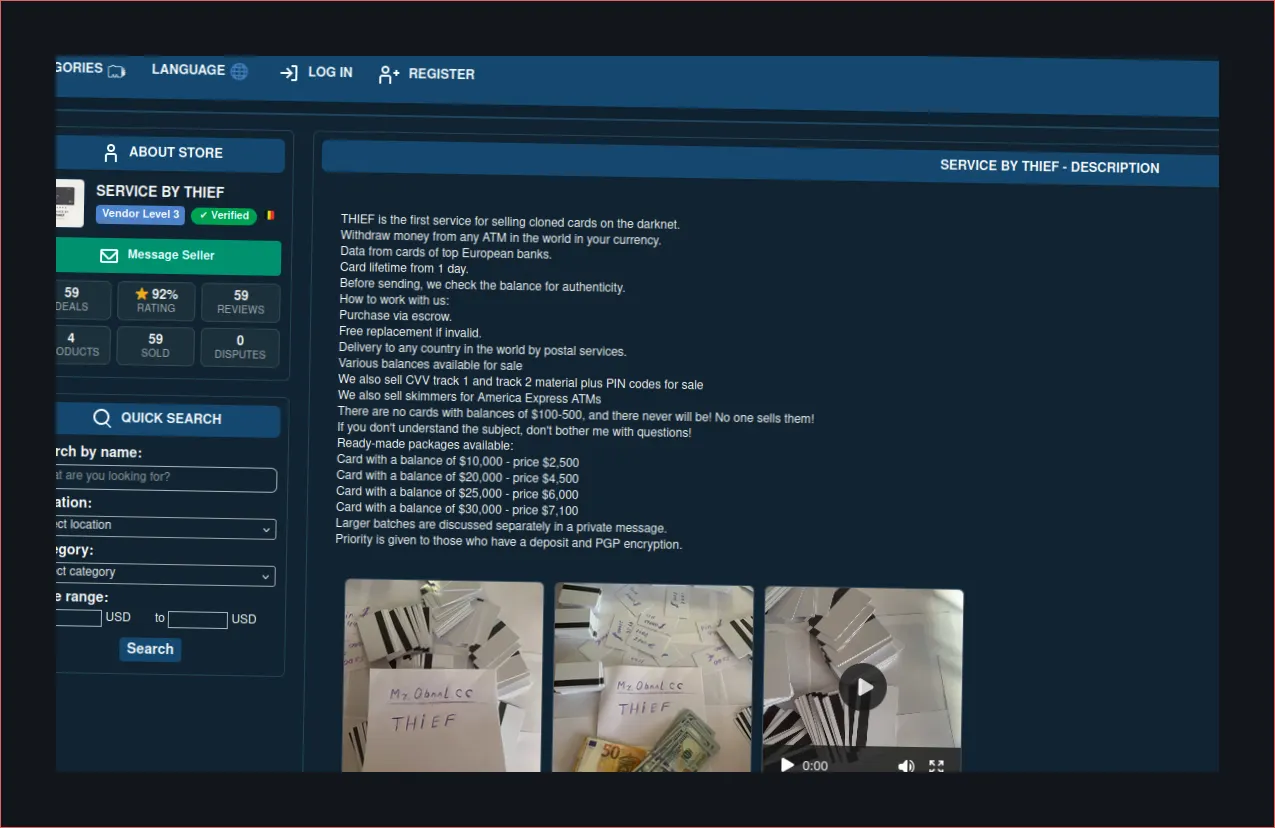
You might assume that buying cloned cards on a darknet marketplace and paying with Monero would keep you invisible. Mark T., a 34-year-old Florida resident, thought the same. He completed his purchase, received the cards by mail in neutral packaging, and began withdrawing cash from ATMs across Tampa Bay. The first three transactions went smoothly, netting him thousands of dollars. But the fourth ATM became the endpoint of his freedom, not because of a technical failure, but because every modern ATM is a surveillance device that records far more than you realize. This case demonstrates how a seemingly anonymous crime in the digital realm collapses the moment it intersects with the physical world. Within 72 hours of his first withdrawal, the investigation had already begun. Within 15 days, Mark was in custody. The story reveals not just how carding works, but how the security infrastructure surrounding financial crime has evolved to close the gap between darknet anonymity and real-world accountability.
What exactly did Mark purchase and how does the carding chain operate?
The process of carding entails the manipulation of stolen banking data, representing a serious risk in the field of cybercrime. Mark's actions exhibit a repetitive pattern that begins long before he interacts with an ATM. Initially, criminals gather magnetic stripe data—both track 1 and track 2—by employing skimmers at ATMs, which may include shimmer devices inserted into card slots, phishing tactics, or obtaining dumps from dark web sources. After acquiring this data, it is encoded onto blank magnetic stripe cards using a device known as an MSR. These counterfeit cards are crafted to display a name, expiration date, and card number that closely mimic genuine credit cards. If the PIN was compromised during the theft—obtained through methods such as overlay keypads or concealed cameras—the buyer possesses all necessary information for cash withdrawal. The concluding phase of this operation involves withdrawing cash from ATMs before the victim detects any discrepancies and informs their bank to block the card. To obscure the financial trail, cash is often converted into cryptocurrency using Bitcoin ATMs or peer-to-peer exchanges, thereby dissociating physical cash from digital identity.
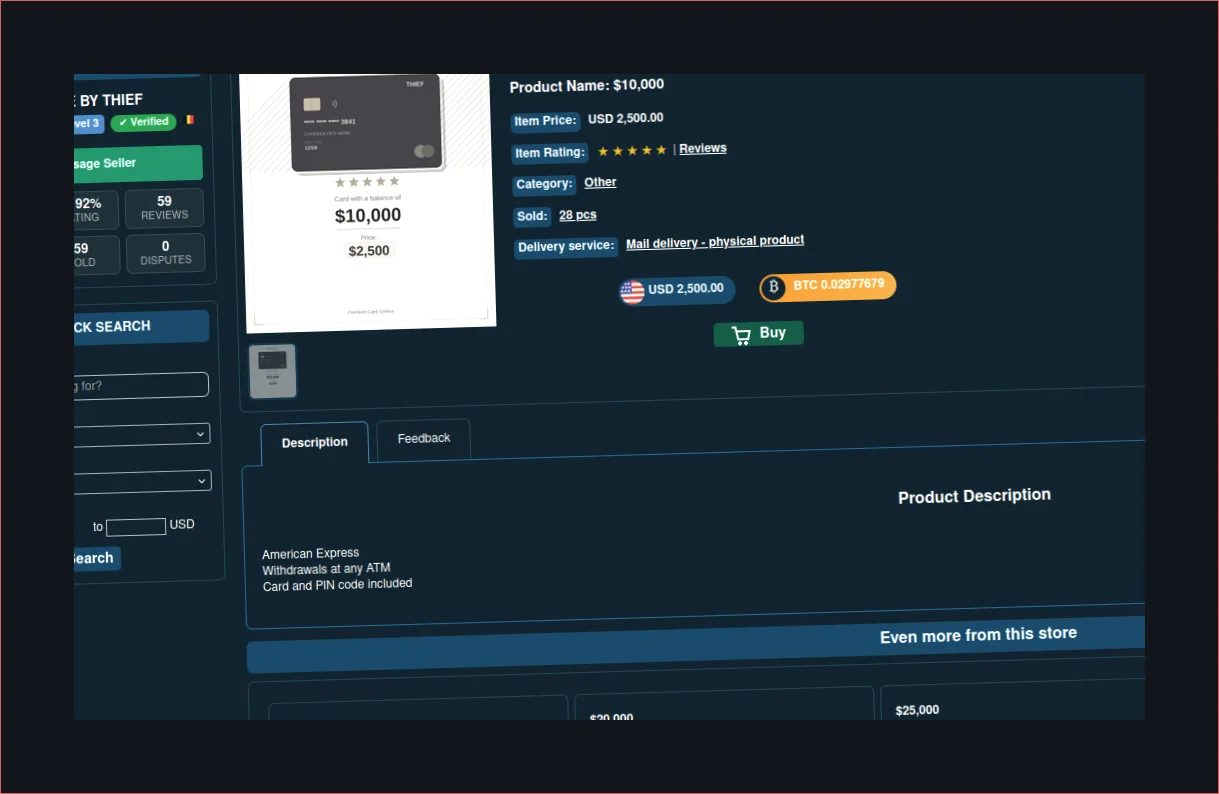
Mark procured a total of six cards from a specific online marketplace, spending $480 in Monero, a cryptocurrency selected for its ability to avoid blockchain scrutiny. The cards were shipped discreetly, with packaging that concealed their true nature. After confirming the transaction's success, Mark tested the cards at various ATMs in the Tampa Bay region. His initial withdrawal yielded $700, followed by $1,200 from another machine, and then $2,300 from a third. By the time he reached a fourth ATM, he had amassed $4,200 in cash. However, he underestimated that each of these ATMs was not just dispensing cash; they were recording evidence of his actions.
How to tell if a card reader has a skimmer and why ATMs are evidence collection systems?
Before accessing an ATM, it’s essential to recognize that contemporary machines are outfitted with sophisticated security features designed to safeguard both the financial institution and its customers. A modern ATM is equipped with a camera that focuses on the user's face, capturing footage in 1080p resolution, and frequently includes infrared lighting for operation in low-light conditions. Moreover, certain models possess a hidden camera that records from a different angle, enhancing surveillance. Each transaction is carefully documented, logging details such as transaction time, withdrawal amount, card number, ATM serial number, and transaction status, all of which are transmitted to the bank's processing system. Additionally, the ATM records its geographical location and network information, creating a digital footprint for every interaction. While withdrawing $700 from an ATM in a Tampa Bay suburb, Mark's face was clearly recorded by the primary camera without any obstructions such as masks or glasses. He withdrew $700, retrieved his card, and left within just 23 seconds. This brief video played a crucial role in connecting him to subsequent investigations.
To identify the presence of a skimmer on an ATM, it is advisable to carefully examine the card slot and the keypad for any signs of tampering before inserting your card. Look for any loose parts, components that seem out of alignment, or unusual surface textures that differ from the rest of the ATM. Also, assess whether the keypad appears thicker than usual, which may indicate an overlay device. Comparing this ATM with others in the vicinity can help reveal discrepancies. Familiarizing yourself with images of ATM skimming devices available online will provide a clearer understanding of what to watch for. To enhance your protection against card skimming, consider utilizing contactless payment options whenever feasible, as they create one-time codes that are not reusable. Additionally, utilizing an RFID-blocking sleeve can safeguard against unauthorized wireless data access. While it is practical to know how to detect credit card skimmers, in Mark’s case, the ATM was functioning correctly; it was his use of counterfeit cards that initiated the inquiry.
How did investigators trace Mark from ATM video to arrest in 15 days?
The swift advancement of the investigation illustrates the capabilities of modern fraud detection techniques. It all commenced on Day 1, in November 2024, when reports of unauthorized cash withdrawals emerged from three individuals located in Florida, Georgia, and North Carolina. In response, their banks swiftly disabled the compromised cards and initiated the first steps of an investigation by logging these incidents into a fraud alert database. By Day 3, advanced anti-fraud systems detected a troubling pattern: multiple transactions utilizing cloned cards took place across various states in a condensed timeframe. This automated identification prompted a referral to the bank's internal fraud investigation team.
On Day 5, the U.S. Secret Service, the federal agency responsible for tackling financial crimes, took charge of the matter. Analysts from the Secret Service sought transaction data and surveillance footage from the ATMs associated with the fraudulent withdrawals. The identification of Mark T., an individual without any prior criminal history, resulted from cross-referencing the driver's license database from the Florida Department of Public Safety with the footage captured by one specific ATM on Day 8, which presented a clear image of a suspect. By examining the transactions, investigators strengthened the connection, revealing that a 40-mile radius of his home was where the withdrawals occurred.
On Day 12, investigators obtained a warrant to scrutinize Mark's digital presence, encompassing browser history, records from his internet service provider, and transactions involving his cryptocurrency wallet. This investigation into ISP logs revealed connections to Tor exit nodes during the time that aligned with purchases made on a darknet marketplace. A court order was executed to connect Mark's Monero wallet to an account on this illicit marketplace. During the execution of a search warrant on Day 14 at Mark's home, law enforcement uncovered packaging associated with the card shipment, $3,200 in cash, a laptop that indicated visits to darknet sites, a device for reading and writing magnetic stripes, and six blank plastic cards.
Mark was apprehended on Day 15. During the interrogation, he acknowledged that four of the cloned cards he used were employed for cash withdrawals. Before he had the chance to use them, the bank had already deactivated the last two cards. This case underscores the significance of timely reporting and the intricate relationship between digital and physical evidence in combating financial crime.
What were the financial and legal consequences of the scheme?
Mark's prosecution illustrates the stark realities of payment card fraud. Over a span of just 15 days, he executed four separate cash machine transactions that netted him $4,900. His investment in six counterfeit cards was $480, leaving him with $4,420 before authorities intervened. The federal court imposed a 60-month prison term—equivalent to five years—along with three years of post-incarceration supervision. Additionally, the judge ordered $22,000 in fines and restitution to be paid to the three account holders who suffered losses. During sentencing, the judge noted that while Mark was not the architect of the scheme, he served as the final operator who physically withdrew the funds. This final operator, however, bears the harshest penalties, while those orchestrating the operation from behind the scenes typically escape consequences.
| Data point | Figure |
|---|---|
| ATM transactions executed | 4 |
| Withdrawn was the amount of $4,900 in total. | |
| The expense for cloned cards is $480. | |
| The number of days between the withdrawal and the arrest was 15. | |
| A sentence of 60 months in a federal prison, equivalent to 5 years, has been handed down. | |
| The amount designated for fines and restitution reaches $22,000. | |
| A period of 3 years has been set for supervised release. |
Mark bought his six cards on the website where the purchase was made, paying $480 in Monero, a cryptocurrency chosen specifically for its resistance to blockchain analysis.
Why did paying with Monero fail to protect Mark's identity?
You may assume that utilizing Monero, a cryptocurrency intended to ensure privacy, would protect your identity. Mark was under the same impression. However, the investigation was able to pinpoint him, highlighting the vulnerabilities associated with attempts to maintain anonymity in both online and offline transactions. The key weakness was at the purchasing stage. Mark engaged with a centralized exchange that necessitated KYC verification to obtain Monero, which involved submitting a scanned passport and a photograph of himself for account setup. Following the issuance of a court order, this exchange divulged his complete identity along with his transaction details. While Monero's blockchain offers a layer of concealment for transactions after acquisition, the initial purchase through a KYC-compliant platform formed a permanent connection between Mark's actual identity and the cryptocurrency utilized for acquiring the cards.
The timing of his transactions further implicated him, as the purchase of Monero, the transaction on the darknet platform, the card receipts, and the ATM withdrawals took place in a tight two-week timeframe. This clustering of events served as circumstantial evidence that, when combined with additional findings, constructed a robust case against him.
Moreover, physical evidence played a significant role in his conviction. The cloned cards that law enforcement recovered during the investigation contained magnetic stripe information that corresponded to data taken from three victims. This tangible link could not be obscured by any cryptocurrency activities. Most critically, the ATM surveillance footage recorded Mark's face without any form of concealment. Even if all other facets of his operational security had been flawless, the footage alone would have associated him with the crime scene. Discussions on platforms like reddit often delve into technical strategies for safeguarding against credit card skimming, yet they frequently overlook the fact that being physically present at an ATM represents a substantial vulnerability. The convergence of digital privacy and real-world actions is where numerous carding operations falter.
What specific mistakes did Mark make that led to his capture?
Mark's lapses in operational security serve as a valuable guide on what pitfalls to avoid when examining how law enforcement apprehends criminals. To begin with, all four of his cash withdrawals were executed within a 40-mile distance from his residence, which immediately triggered alerts in anti-fraud systems designed to monitor geographic patterns. Additionally, he failed to mask his identity in any way. Without wearing a mask, glasses, or hat, he left his face fully visible to the ATM cameras, making it easy for facial recognition technology to identify him through manual checks against driver's license records.
Moreover, he utilized a centralized exchange to acquire Monero and completed the Know Your Customer (KYC) verification process, linking his legal identity to the cryptocurrency transaction. This action removed any potential anonymity that the blockchain technology could have offered him. Furthermore, he kept incriminating materials in his home. Through the investigation, the discovery of cash, a magnetic stripe reader, cloned cards, and a laptop that suggested the use of the Tor Browser established critical evidence against him. It's worth noting that even deleted files and internet browsing history can often be retrieved through forensic examinations, and operating system logs can indicate how and when software was used.
Additionally, the $3,200 in cash that was confiscated during the search corresponded with the denominations and order of bills dispensed by the ATMs he accessed, providing further support for the prosecution’s claims. Lastly, he condensed all his illicit activities into a mere two-week timeframe. Had he distributed the withdrawals over a longer period, the anti-fraud system may not have reacted as swiftly; however, the ATM cameras would still have documented his actions. These missteps are frequently observed in individuals who fail to appreciate the interplay of physical surveillance, digital forensics, and automated fraud detection systems. Recognizing that each security layer is designed to address the vulnerabilities of the others forms a more resilient defense than any single measure could provide.
What lessons should security professionals take from this case?
Mark's situation illustrates not the complexities of advanced cybercrime, but rather how contemporary security measures respond when both physical and digital traces intersect. Individuals involved in cybersecurity and fraud prevention can draw several key insights from this case. Firstly, it's crucial to recognize that anti-fraud systems often act as the initial barrier against threats, functioning autonomously before any human intervention occurs. These systems employ algorithms for pattern recognition, geolocation parameters, and scoring models that automatically trigger alerts when anomalies are detected. To enhance their defenses, banks and financial institutions must prioritize investment in advanced machine learning technologies that swiftly detect irregular activities, significantly outpacing manual evaluations.
Secondly, a seamless collaboration between physical and digital forensic methodologies is imperative. Although the footage from the ATM played a pivotal role in the investigation, it was the digital transaction logs that provided necessary timestamps, enabling law enforcement to extract the correct video frames. This synthesis of physical and digital evidence forms the backbone of successful investigations.
Another crucial point to consider is the misconception surrounding cryptocurrencies that advertise anonymity. The entry point—utilization of a KYC exchange—and the exit point—cashing out—create a connection between digital transactions and physical identities. In the context of KYC regulations, achieving complete anonymity is largely unfeasible for most users. Furthermore, raising awareness among customers remains an essential yet often overlooked aspect of fraud prevention. In this case, victims failed to identify fraudulent activity promptly, allowing Mark more time to withdraw cash. Prompt reporting of unauthorized transactions enables banks to act quickly, minimizing potential losses. Thus, banking institutions should implement educational initiatives to decrease the timeframe in which fraudsters can operate.
Lastly, the ongoing issue of card cloning and skimming devices persists, largely due to outdated payment systems that still utilize magnetic stripes. Encouraging the widespread adoption of chip-and-PIN technology and contactless payment options can reduce vulnerabilities, though it may not completely eradicate fraud risks. It is also beneficial for consumers to become informed about identifying skimming devices and to adopt protective measures against credit card skimming.
The Verdict and the Inescapable Link Between Digital and Physical Crime
In March 2025, it was revealed by Mark T. that he had participated in activities categorized as fraud and money laundering, which are addressed in the provisions of 18 U.S.C. § 1029 and 18 U.S.C. § 1957. After this acknowledgment, a sentence of 60 months in federal prison was handed down to him, along with an additional three years of supervised release. The court imposed a fine of $22,000 on Mark, who also faces the obligation to provide restitution to three victims affected by his actions. It is noteworthy that the judge clarified Mark was not the mastermind behind these fraudulent schemes; he merely represented the final link in a lengthy series of events, facing the repercussions of the illegal acts. This scenario emphasizes the challenges law enforcement faces in tracking down the primary offenders, who often successfully evade capture while less influential participants bear the majority of the penalties.
This instance serves as a vital reminder that the digital anonymity often perceived does not carry over into the physical realm. Every transaction made at an ATM, each piece of footage from surveillance cameras, and all cryptocurrency exchanges that comply with know-your-customer regulations create a traceable pathway for law enforcement. The combination of fraud detection technologies, surveillance, transaction logs, and forensic investigations establishes a comprehensive security framework that often surpasses what criminals expect. For individuals working in security, this case highlights the necessity of implementing thorough security protocols and raising awareness among both consumers and businesses about the ever-evolving strategies employed in financial fraud.